
Federal Release Paths Near Clearwater
Federal custody is not one continuous public record. The U.S. Marshals Service manages many people detained before trial, handles transport, and moves sentenced prisoners toward BOP custody. USMS states that many federal prisoners are housed in state, local, or private facilities. A person can therefore be in federal custody without being in a federal prison, and the physical bed can be far from Clearwater County.
A federal judge may order pretrial release, detention, remand, or release after acquittal. “Remand” means the court orders the person into custody, often pending the next stage. If a prison sentence follows, USMS may deliver the person to BOP. Later, a BOP release can lead to the community, another sovereign's custody, immigration custody, or court-ordered federal supervised release. Supervised release is a community status imposed by the federal court, not BOP confinement.
The correct flow is: federal court event → USMS or physical holding facility → BOP after commitment, if applicable → BOP release or transfer → federal court supervision or another custodian. A Clearwater County jail-roster deletion cannot prove any part of that federal sequence unless a reliable record first connects the person to the local jail and identifies the receiving authority.
Confirm BOP Inmate Releases
The BOP Inmate Locator covers federal prisoners incarcerated from 1982 to the present. Search by an official number when known. Accepted identifiers include a BOP Register number, DCDC number, FBI number, or INS number. A name search also permits race, sex, and age filters. Identifiers are safer than name alone because a shared name can produce several candidates.
Read the location or status and the displayed date together. A past release date combined with “Released” or “Not in BOP Custody” and no assigned facility supports the conclusion that BOP confinement ended. The phrase does not establish that the person is physically free. A county, state, immigration agency, or another authority may have taken custody, and federal supervised release remains separate from BOP custody.
- Search the BOP locator by federal identifier whenever possible, then use the name and filters only as a fallback.
- Open or read the matching result and compare identity details before accepting the status.
- Record the exact location or status phrase and its date. Treat a future date as projected, not completed.
- Check the federal case docket for the sentence, release order, later detainer issue, or supervised-release terms.
- If another authority appears in the docket or record, continue with that custodian rather than calling the BOP event a community release.
BOP warns that First Step Act recalculation can affect projected dates. Recheck a future date near the expected event and use the federal docket for the current legal posture.
Read Federal Release Results
A BOP locator result is concise, which makes careful interpretation important. The number and name help identify the person. The location or status states BOP's relationship to the person, and a displayed date may describe a release or a projected event. A result should not be expanded into claims the locator does not make.
| BOP result item | What it can establish | What it cannot establish |
|---|---|---|
| Federal identifier | The matched BOP record | Identity without comparison to known facts |
| Current facility | Active BOP placement shown by the locator | Permanent placement or a future release |
| Released | BOP custody ended as recorded | No custody by another authority |
| Not in BOP Custody | BOP is not the current custodian | Community freedom or no supervision |
| Future date | BOP's current projected timing | A completed release event |
The successful manifest capture comes from the official locator. Open the BOP federal inmate search to review the live search and current result wording.
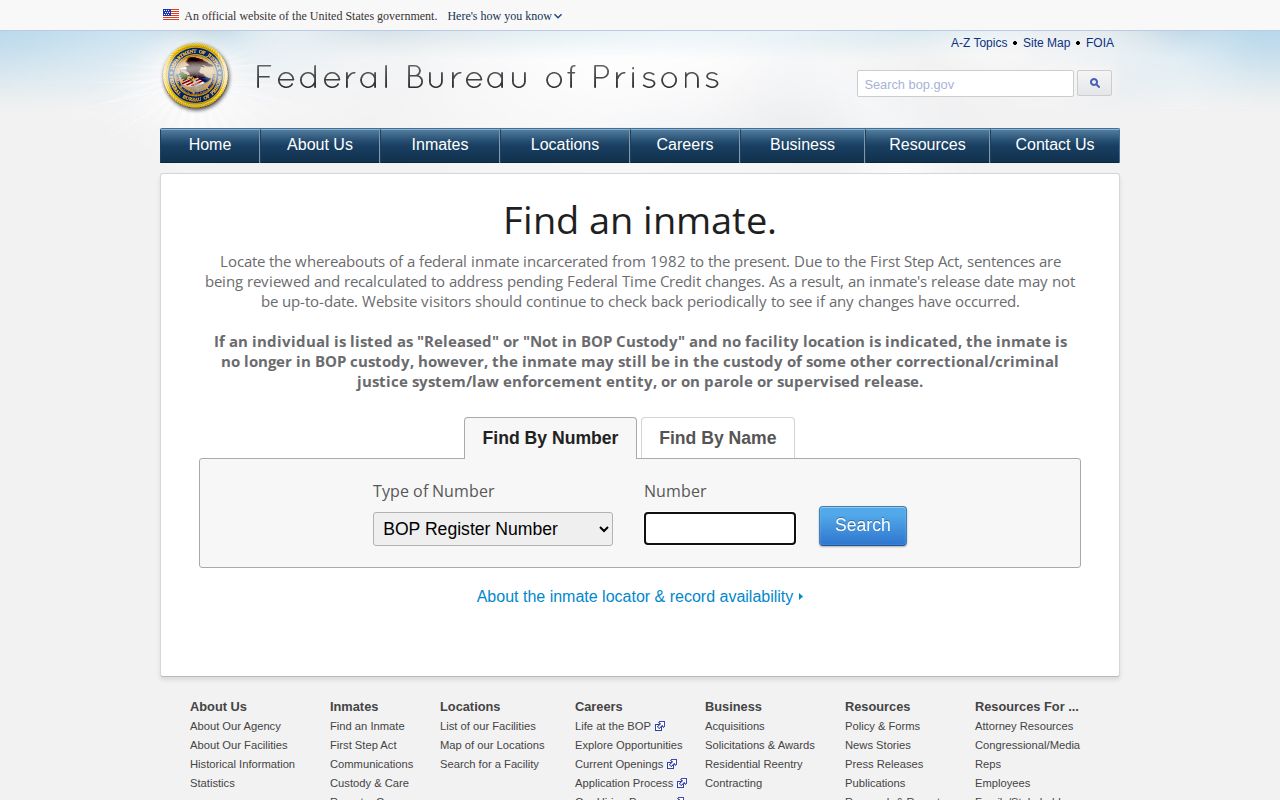
The locator provides a BOP custody answer, while a federal docket or receiving-agency record supplies the legal and post-custody context.
Note: BOP records begin with federal prisoners incarcerated from 1982 onward, so older history requires a different federal records path.
Verify USMS Release Events
The U.S. Marshals Service has no public nationwide released-prisoner locator. That absence changes the search order for a federal pretrial detainee. Start with PACER federal court records to locate the correct criminal docket. Read detention, bond, release, remand, sentencing, acquittal, and commitment entries in date order. The court order supplies the legal authority but may not provide the precise physical exit time.
Next, identify the facility that actually held the person. It could be a local, state, private, or regional jail used by USMS. Contact that facility for the custody event and ask the responsible Marshals district to confirm USMS status when appropriate. The USMS custody and detention overview explains the agency's role in housing and moving prisoners, but it is not a person-search database.
- Find the federal case in PACER and verify the defendant using the case number and known identity details.
- Read the latest custody order and determine whether the person was released, remanded, sentenced, or committed to BOP.
- Identify the physical holding facility from the docket, counsel, or responsible Marshals district.
- Ask that custodian for the actual release or transfer event. If BOP commitment occurred, switch to the BOP locator.
A federal court release order can be followed by a separate hold. Likewise, delivery to BOP is not community release. Keep the court, physical custody, and post-release layers separate until all three agree.
Timing also matters. A docket entry may show when an order was signed, not when staff at the holding facility carried it out. Ask the physical custodian for the recorded release or transfer time when that detail is needed. If the docket later identifies a BOP Register number, use it to bridge the pretrial record to the sentenced-custody record without assuming the move happened on the judgment date.
Clearwater Federal Release Limits
No official source reviewed identified a BOP prison or dedicated USMS detention facility inside Clearwater County. National USMS use of local beds does not establish a Clearwater contract. Do not infer federal custody merely because a person once appeared on the Clearwater current inmate roster or because a local booking disappeared.
If a Clearwater sheriff record identifies a federal handoff, preserve the receiving-agency name, date, and booking or case identifiers. The official Clearwater County Jail page gives the local contact, while the county information-request form provides the documented records route. Then use the federal docket or BOP record as appropriate. If the record instead shows transfer to Minnesota DOC, the correct search is the state Public Viewer. Immigration custody uses its own locator and should not be folded into BOP status.
The county lists Sheriff Darin Halverson as of the research date. The Sheriff's Office can address its own release or transfer entry, but it cannot certify later BOP or USMS custody. That later fact must come from the federal record or physical custodian.
- Federal pretrial custody
- Court-directed detention managed by USMS, often in a nonfederal physical facility.
- BOP custody
- Federal prison custody after commitment to the Bureau of Prisons.
- Federal supervised release
- Court-imposed community supervision after imprisonment; it is not BOP confinement.
- Detainer
- A notice or request that another authority may seek custody when the present custodian releases the person.
The Clearwater County released-inmate search supplies the county-first path when the last known event began at the local jail. The federal path should start only when a docket, transfer record, hold, or other reliable source identifies federal involvement.
Federal Release Record Sources
The best federal release record depends on the stage. For USMS pretrial custody, seek the federal court order and the actual holding facility's custody record. For a sentenced prisoner, preserve the BOP number and exact locator result. If a later state, county, or immigration hold appears, obtain the receiving custodian's record rather than asking BOP to explain another agency's custody.
Federal Custody Sources
BOP sentenced custody: BOP Inmate Locator and BOP record information
USMS pretrial custody: PACER, the physical holding facility, and the responsible U.S. Marshals district
Federal court authority: detention, release, remand, judgment, and supervision entries in PACER
Useful request details include the full federal case number, BOP Register number or other federal identifier, recorded name, date of birth when lawfully known, holding facility, and approximate event date. Ask for an existing release, transfer, or custody record. Do not ask one agency to create a narrative about all jurisdictions.
A no-result must be read in context. It can mean the person is in pretrial USMS custody rather than BOP, the identity details are wrong, the record predates locator coverage, or another system holds the relevant event. The absence of a Clearwater federal facility makes jurisdiction checks especially important.
The originating record should carry the conclusion. BOP can state that BOP custody ended. A holding jail can state that its custody ended. The court can state the release or detention authority. When those records point to different dates, preserve each date with its source and ask the custodian to explain its own entry rather than blending them into one unsupported federal release time.