
Clearwater Release Dates Compared
The Minnesota Department of Corrections uses the exact public label Anticipated Release Date on an incarcerated person's detail record when that field applies. People often call it a projected, tentative, or scheduled release date. It is a forecast based on the sentence and the information then held by DOC. It does not promise a gate time and does not describe a Clearwater County Jail release.
An actual release date records a completed move out of a specific custody. The person may then be under supervision, transferred, or held by another authority. An Expiration Date concerns the end of the total sentence. On an under-supervision DOC record, the confinement display may be replaced by “Current Status: Under Supervision as of” a date and an agent. That status shows continued DOC jurisdiction after prison confinement ended.
Scheduled versus actual: An Anticipated Release Date is a changeable forecast. An actual custody event must be confirmed through the responsible facility, release record, or updated official status.
- Anticipated Release Date
- The MN DOC public label for a computed future prison-release date when displayed.
- Actual release
- The completed end of one custodian's physical confinement.
- Expiration Date
- The end of the full correctional sentence, including supervision when applicable.
- Detainer
- A request or legal basis for another authority to take or continue custody.
Find a Clearwater Release Date
First decide whether the person is in Clearwater County Jail, an MN DOC facility, or another system. The MN DOC Public Viewer is the official state-prison path. It permits an MNDOC Offender ID search and a prefix-based name search that can include former last names. A new commitment can take several business days to appear, so a gap between the county roster and the state record may reflect transport and intake rather than release.
- Identify the last confirmed custodian and locate the relevant Clearwater court case or booking.
- For state prison, search by MNDOC Offender ID when known. Otherwise use the name and verify the court file and other identifiers.
- Open the correct detail record and look for the exact label “Anticipated Release Date.”
- Read that field beside the current status, facility, sentence information, and Expiration Date.
- For county jail, read the sentencing or release order and ask the jail for its existing release-calculation or custody record.
- Confirm a future state date with the listed facility or DOC Central Records before making plans around it.
The successful manifest image is an official public DOC detail example. View the MN DOC example with Anticipated Release Date to see how that label sits apart from Expiration Date.
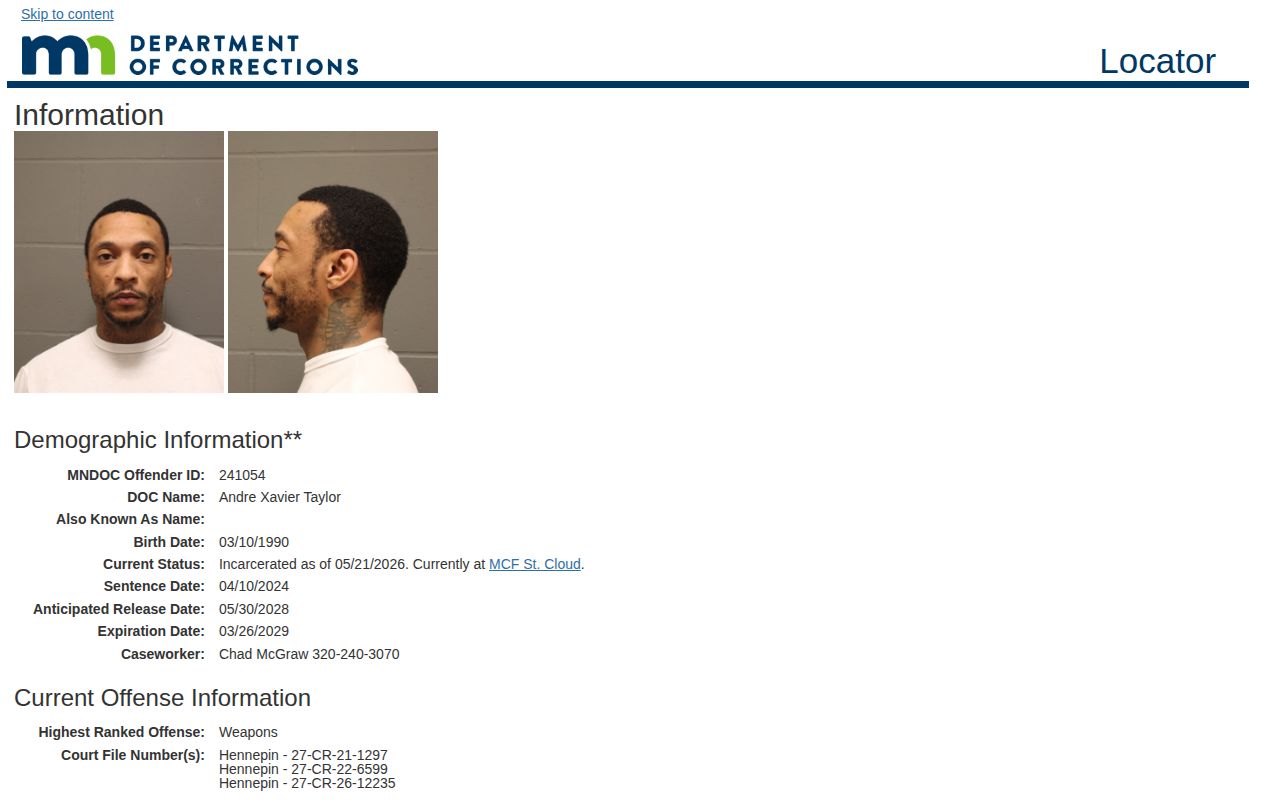
The layout shows why copying one date without its label or status can mislead. Field availability varies by person and sentence, so do not assume every record shows the same set.
When the Viewer does not answer a state-sentence question, MN DOC Records Management handles release, discharge, supervision, and sentence-status data requests. The office can be reached at 651-361-7330 or CO-Records.DOC@state.mn.us. Ask for existing public fields rather than a new calculation or legal opinion. DOC states that inspection of public data is free, while copies may carry the stated per-page or actual retrieval, copying, and delivery costs.
Note: The Public Viewer covers adults who remain under DOC jurisdiction, not every person ever held in Clearwater County.
Clearwater Jail Release-Date Limits
The official Clearwater County roster displays mugshot, name, booking date and time, and charges or hold reasons. It has no labeled scheduled release, actual release, release reason, destination, or archive selector. The county says the roster attempts updates every 60 minutes, but removal from that current list does not reveal why custody ended.
A pretrial detainee has no fixed sentence-based date. Bond may be posted, a court may change the conditions, a charge may be dismissed, or another hold may block physical release. For a locally sentenced person, use the judgment, jail credit, and later court orders, then ask Clearwater County Jail for the existing release calculation or custody-event record. The jail is at 213 Main Avenue North, Department 101, Bagley, and the Sheriff's main number is 218-694-6226. The Sheriff's Office is led by Sheriff Darin Halverson as of the research date.
A date-bounded county request can ask for the release sheet, jail-register entry, or custody-event log tied to the known booking. Include the recorded name, approximate admission period, booking number when available, release date and time, event type or authority, and public transfer destination. Clearwater County need not create a new record. Asking for inspection first can help locate the right existing document before copies are ordered.
Do not apply a state-prison sentence fraction to a local misdemeanor jail term. The legal rules and data source differ. The county record gives the actual exit event, while the court file supplies the legal authority. A transfer to DOC or another county ends the Clearwater booking without establishing community freedom.
Minnesota Two-Thirds Release Rule
For an ordinary fixed executed felony sentence tied to an offense committed on or after August 1, 1993, Minnesota Statutes § 244.101 divides the sentence into a minimum imprisonment term of two-thirds and a maximum supervised-release term of one-third. Two-thirds is about 66.7 percent. Minnesota's ordinary modern baseline is not an 85 percent truth-in-sentencing rule.
A simple illustration can show the structure but cannot calculate a person's calendar date. A 36-month executed sentence has a baseline 24-month imprisonment part and a 12-month supervised-release part. The responsible authority must still apply the sentencing date, jail credit, consecutive or concurrent terms, conditional-release requirements, court changes, disciplinary confinement, and any earned-incentive decision. The court must explain the total sentence, expected prison portion, supervised portion, and the risk that discipline can extend confinement.
Supervised release does not erase the rest of the sentence. It moves the person from prison confinement into community supervision under DOC jurisdiction. The Clearwater County Post-Release Supervision record is therefore distinct from final discharge and sentence expiration.
Clearwater Release Credits and Discipline
Older “good time” rules are narrow. Minnesota Statutes § 244.04 provides a one-day reduction for every two rule-compliant days for qualifying presumptive fixed sentences tied to crimes before August 1, 1993. It is not the routine rule for modern Clearwater convictions. Calling every current release reduction “good time” hides the date and sentence limits that control the statute.
The Minnesota Rehabilitation and Reinvestment Act creates earned incentive release credit tied to objectives in an individualized rehabilitation plan. Sections 244.41 through 244.45 set the framework. Section 244.44 caps credit at 17 percent of the total executed sentence, bars a reduction below one-half of the executed term, keeps the total sentence length unchanged, and allows revocation for rule violations or criminal acts. Life sentences, old indeterminate cases, and people governed by the old good-time system are among the exclusions in § 244.45.
Never subtract 17 percent automatically. It is a ceiling, not a guaranteed award. Eligibility, an approved plan, completed goals, DOC policy, exclusions, and later revocation all affect the result. Section 244.05 also permits disciplinary confinement for violations or refusal to take part in required programming. Added confinement can reduce time in the community and move an anticipated date toward sentence expiration.
Why Clearwater Release Dates Change
A projected date is recalculated when the controlling facts change. Some changes come from conduct in custody. Others come from courts, other jurisdictions, or the sentence structure itself. The exact effect belongs to DOC, the court, or the jail that maintains the calculation.
| Factor | Possible date effect | Best confirmation |
|---|---|---|
| Disciplinary confinement | Can delay supervised release toward expiration | MN DOC record and Central Records |
| Earned incentive credit | May advance release within statutory limits | Live DOC date and individualized decision |
| Jail credit | Changes the credited time applied to confinement | Judgment, sentencing record, and DOC calculation |
| Concurrent or consecutive terms | Changes how sentence periods overlap or stack | Sentencing documents and agency calculation |
| Court order or sentence correction | Can change the legal term or release authority | Latest court order |
| Detainer or receiving hold | May prevent community release after one custody ends | Custodian and receiving agency |
| Board action in a covered case | Can assign, continue, deny, defer, or rescind a plan | Board materials and updated DOC status |
A detainer does not always alter the mathematical end of one sentence. It can instead change where the person goes when that custodian releases them. That is why a projected date and a destination must be verified separately.
Special life and indeterminate sentences follow different paths. The Minnesota Supervised Release Board may review covered cases and assign a projected date or continue a case with directives. A listed review date is not a release promise, and no stand-alone public Board decisions database was located. Use the current review schedule, the updated Public Viewer record, and the Hearings and Release Unit for the latest public result.
Minnesota Weekend Release-Date Shift
Minnesota has an unusual state-prison timing rule in § 244.05, subdivision 1a. For crimes committed on or after August 1, 1992, when scheduled supervised release falls on Friday, Saturday, Sunday, or a holiday, release begins on the first later day that is not one of those days. For older crimes, the statute uses the preceding eligible day.
This rule is specific to Minnesota DOC supervised release. It is not a published Clearwater County Jail weekend policy. The county jail page gives no release-processing hours, weekend method, or release door. Local operational timing should be confirmed with the jail rather than inferred from the state-prison statute.
Important: Do not move a Clearwater jail date with the DOC weekend formula. Use the statute only for the covered state-prison sentence.
Confirm Clearwater Actual Release
Recheck the responsible system near the anticipated date. For state prison, compare the Public Viewer with the facility or DOC Central Records. For county custody, obtain the sheriff's actual release sheet or custody-event entry. A Clearwater County District Court order can explain the authority but may not record the physical exit time or a later handoff.
Prospective county-jail notice is available through Minnesota VINE. The Clearwater County VINE Inmate Check explains how to register on the correct record and why a transfer event requires a switch to Minnesota Haven for state-prison notices. Neither service turns a future estimate into a guarantee. The final answer comes from an updated official status and the completed custody record.
Keep the custody result and the sentence result separate. The first tells whether a named authority still holds the person. The second explains the legal term and any remaining supervision. When a release is complete, the actual agency record should replace a saved projected date as the primary evidence of what occurred.